Clive
Powell was born in Leigh, Greater Manchester, on 26th June
1943. He started playing piano at an early age for various
local groups, including The Dominoes (named after his hero,
Fats Domino), before he moved to London in 1959.
Songwriter,
Lionel Bart, spotted the brilliant 16 year old and recommended
him to pop manager, Larry Parnes, who immediately signed the
youngster, renaming him Georgie Fame in the process.
Georgie
played piano in many of Larry Parne's backing bands for the
likes of Marty Wilde and Vince Eager before joining Billy
Fury's The Blue Flames in June 1961. When Billy Fury replaced
The Blue Flames with The Tornadoes, Georgie decided to front
the band himself.
Georgie
Fame and The Blue Flames secured a residency at a London jazz
club called The Flamingo where they built up a huge following,
earning a contract with EMI 1963. They recorded their debut
album, "Rhythm
& Blues At The Flamingo", live at the club
although it was released without success. The album, along
with the "Rhythm
& Bluebeat" EP, featured West Indian set-works
that had been in his stage set since1962.
The
follow-up album, "Fame
At Last", reached No 15 in the UK Album Charts
(1964) and spawned Georgie's first hit single; his cover of
Jon Hendrick's "Yeh
Yeh". reached UK Number 1 (it reached No.21 in
USA) and sold over a million copies, knocking The Beatles'
"I Feel Fine" off the Number One spot after
a six week stint.
Hit
single after hit single followed; "In
The Meantime" (No.22), "Like
We Used To Be" (No.33) and a cover of John
Mayall's "Something"
(No.23) were surpased by Georgie's second UK Number 1, "Getaway"
in 1965, whilst his cover of Bobby Hebb's "Sunny"
reached Number 13.
Despite
their early success, Georgie Fame disbanded The Blue Flames
in 1966 to pursue a solo career. With backing musicians including
the brilliant John McLaughlin, Jon Hiseman and Mitch Mitchell,
he adapted a less complimentary commercial pop sound. Meanwhile
ex-Blue Flame, Mitch Mitchell, joined the Jimi Hendrix Experience.
His
first single with the new line-up, a cover of Billy Stewart's
"Sitting In
The Park" reached Number 12 and heralded the
Top Ten album, "Sweet
Thing" (UK No.6) which noted Jazz legends Stan
Tracey and Tubby Hayes. The follow-up singles also scored
chart success; "Because
I Love You" reached No.15 although "Try
My World" failed to go any higher than No.37.
His
next albums also scored impressive chart success; "Sound
Venture", reached Number 9 in the UK, whilst
"Hall Of Fame" charted at Number 12. His 1967 "Two
Faces Of Fame" album was recorded both live and
in the studio, capturing both sides of Georgie at his best.
It reached No.22. He also performed with the Count Basie Orchestra
at the Royal Albert Hall in London.
Inspired by the movie 'Bonnie & Clyde', Georgie recorded
"The Ballard
of Bonnie & Clyde" in December 1967, and
despite his rather annoying false American accent, scored
his third UK No 1 hit single (No.7 in USA), becoming his all-time
best-seller in the process, shifting over a million copies.
It was also included on the album "The
Third Face Of Fame".
In
1968, Georgie sang the theme song for the Elizabeth Taylor
and Richard Burton film, 'Goforth'. The singles "By
The Time I Get To Phoenix" and the UK No.16 hit,
"Peaceful",
followed whilst the 1969, No.25 single "Seventh
Son" was included on the album of the same name,
which also spawned "Somebody
Stole My Thunder".
"Fire
and Rain" failed to break the singles chart whilst
the albums "Georgie
Fame Does His Own Things With Strings" (1969),
and "Going Home"
(1971) also flopped.
Teaming
up with organist Alan Price (ex-Animals), Georgie continued
to release very lightweight pop singles, and their album "Fame
and Price" failed to sell as a result. The partnership
was ended in 1973 after three mediocre singles (the UK Number
11 "Rosetta",
"Follow Me"
and "Don't Hit
Me When I'm Done").
The
albums "All
Me Own Work" and "Fame
Again" failed to sell as did a string of singles
and possibly as a result of heavy criticism, poor sales and
a dwindling fan-base, Georgie decided to revive his old R&B
days. He re-instated The Blue Flames (of which only Colin
Green remained from the original line-up) and signed to Island
Records releasing the album, "Georgie
Fame", to little success in 1974. The band again
fizzled out without failing to rediscover any of their original
roots.
Disappearing
from the public eye, Georgie even took to writing jingles
for television advertisements and appeared in coffee commercials
whilst his albums, "Daylight"
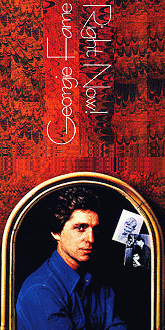
(1977), "Right
Now", "That's
What Friends Are For" (both '79), and "Closing
The Gap" (1979) all failed to sell.
The
1980's saw Georgie Fame strengthen his jazz connections and
the 1981 "In
Hoagland" album included a collaboration with
Hoagy Carmichael and Anne Rice. The 1985 "Together"
album was soon followed by a further collaboration, this time
with Lena Ericson and Lasse Samuelson. 1988's "No
Worries" and "Selection
Of Standards" failed to win any recognition,
although he did reappear in a television advertisement for
orange juice. He did however return in 1991, better than ever,
with "Cool Cat
Blues".
1995's
"Three Line
Whip" saw Georgie form an interesting collaboration
with his sons, James and Tristan, whilst "The
Blues & Me" in 1996 also won praise. It was
his work as keyboard player and musical producer for Van Morrsion
however that pushed the talented musician back into the limelight.
Together they recorded "How
Long Has This Been Going On" and "Songs
Of Mose Allison: Tell Me Something" whilst Georgie
has also contributed to all of the Irish star's albums since
1990. These include "Enlightment", "Hymns
To The Silence", "Too Long In Exile", and
"Healing Game".
1997
saw Georgie release "Go
Jazz Stars" with Ben Sidran and he also recorded
three tracks ("Melody",
"Motorvatin'
Mama" and the brilliant "Hole
In My Soul") with Bill Wyman's Rhythm Kings for
the amazing "Struttin'
Our Stuff" album before releasing the highly
acclaimed CD's "Name
Droppin'" and the live "Walking
Wounded" in
1998.
Georgie
Fame's music can not be labelled as either jazz nor rythm
and blues - it is somewhere between the two, and his albums
in the 1990's have gathered fans from all musical tastes.
|