|
the hacienda
manchester |
a history of the greatest
nightclub ever |
 |
The
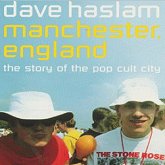
following history of the Haçienda was written exclusively
for Pride Of Manchester by best-selling author and former
Haç DJ, Dave
Haslam in February 2003:
The
Hacienda closed in June 1997 after which it stayed empty
for eighteen months before it was demolished. Bits of
the demolished club were then auctioned off. Bricks were
£5 each; the sale raised thousands of pounds for
charity. Now on the site on Whitworth Street there’s
a block of flats mocking us with its use of the Hacienda
name.
|
But
before we get too deep into the Hacienda’s history
perhaps it’s worth remembering that there have been
dozens of other great clubs and venues that have contributed
to the city’s peerless nightlife scene. Time, though,
is merciless. Other great venues in Manchester’s
recent club history have suffered a similar fate to the
Hacienda’s; on the site of the Gallery on Peter
Street there’s a particularly depressing example
of a Bar 38; the site of the Reno in Moss Side is wasteground;
the Boardwalk is an empty building.
Despite
all this, interest in the Hacienda has never been greater.
In the
late 1980s, the Hacienda was unique. Without the club
there would have been no ‘Cream’ in Liverpool,
and perhaps no Ministry of Sound. Visits to the Hacienda
inspired DJs like Sasha, the Chemical Brothers, Laurent
Garnier, and Justin Robertson.
|
The
recent release of the film (and DVD) ‘Twenty Four
Hour Party People’ is keeping interest in the Hacienda
alive, even though it tells an idiosyncratic version of
the history, mostly based around the story of Tony Wilson
(played by Steve Coogan). You’d have to talk to
some of the longest serving staff members; Leroy Richardson,
Andrew Berry, Angela Matthews or Suzanne Robinson. And
the regulars; everyone has a different version of what
went on at the club. You’d have to collect all those
individual memories to make the complete picture, like
getting back those auctioned bricks from their thousand
different homes.
|
|
Financed
by Factory Records and New Order, the Hacienda was open
for fifteen years. Most nights it opened money was lost.
Peter Hook once claimed that New Order would have been
better off if they’d given ten pounds to everyone
who ever came to the Hacienda, sent them home, and not
bothered with the club at all.
There
were at least a couple of years when it all came together,
though; the end of the 1980s, the Madchester years, the
birth of the rave era. I DJ-ed at the Hacienda nearly five
hundred times, mostly back in the 1980s, and we had some
amazing nights there, but back then, although we knew things
were good, I don’t think anyone would have predicted
that over a dozen years later there would be a film about
those years; it was just a matter of getting out there and
enjoying the weekend. Cameras were rare in the club, although
there
had been one character, Malcolm, who had a company called
Ikon. He filmed New Order, Mantronix, Grandmaster Flash,
the Smiths and all the other acts who ever played there
but then he disappeared into the Pennines and no-one has
heard from him since. |
 |
In
the absence of any major archive or much TV footage, the
makers of ‘Twenty Four Hour Party People’
built a stunning replica of the building in a warehouse
in Ancoats and opened the doors to a thousand clubbers
one Friday night in March 2001 for one of the most talked-about
nights out in Manchester for years. Mike Pickering, Graeme
Park, Jon Da Silva and I DJed, and the night exploded.
It was a farewell party, a celebration, a reunion. Within
a couple of days the replica version had been taken down,
demolished like the original building, but the film-makers
had got some great footage and we’d had a ball.
|
‘Twenty
Four Hour Party People’ is concerned with much more
than the Hacienda, though; it follows the fortunes of
Factory label. Spurred on by punk, Tony Wilson and Alan
Erasmus put on gigs, hosting ‘Factory’ nights
at the Russell Club in Hulme in June 1978, which led to
the formation of Factory Records later in the same year.
In
2003 the music industry seems awash with hot shots and
marketing graduates but Factory and the Hacienda was run
with endearing, exasperating, punk amateurism. Soon Rob
Gretton was on board; a Manchester City fan managing groups,
including Joy Division, the most important band of 1979.
In May 1980, though, Joy Division came to a premature
end when singer Ian Curtis killed himself on the eve of
an Amerian tour. Following this tragedy, the band re-grouped,
and became New Order.
|
Rob
Gretton instigated a joint venture between New Order and
Factory Records, looking for a site for a club of their
own. Others involved in the record company took some persuading.
There’s an episode in the film when Martin Hannett
- New Order’s producer (and co-director of Factory)
- throws a massive strop; he wanted wanted to spend any
spare cash on recording technology. |
|
Late
in 1981 Gretton and friends took a lease on an old yacht
showroom on Whitworth Street West in a semi-derelict part
of town overlooked by a rusting gas works. Making full
use of the warehouse layout - the industrial girders,
iron pillars, and high ceiling - Ben Kelly set about designing
the Hacienda, a very different place to most clubs in
Britain with their sticky carpets and potted plants. The
‘Architectural Review’ called Ben Kelly’s
Hacienda a “pioneering interior”.
Open
from May 21st 1982, the Hacienda was a members-only club,
open sometimes five or six nights a week. Bills weren’t
getting paid and no money being made. Fortunately for
the whole enterprise, New Order had commercial success
with Blue Monday; the single spent 34 weeks in the charts
in 1983 and became the biggest selling 12” record
of the era. The band were persuaded to part with proceeds
from their record sales to support the club’s high
losses.
|
 |
For
all its aesthetic glory, the Hacienda was cursed with
bad acoustics and poor sightlines. The first resident
DJ, Hewan Clarke, was hidden away in a little boxroom
to one side of the stage. He lobbied for the DJ box to
be moved from the bunker and a wooden structure on the
balcony was eventually built, overlooking the dancefloor.
Ben Kelly claimed his design was being compromised, but
it was the perfect move, pre-empting the shift to club
nights and the rise of the superstar DJs.
|
But
in those early years the club would often be empty. I’d
sometimes be there, a paying customer, possibly the only
one. I’d sit at one of the balcony tables watching
the videos projected onto a big screen and listening to
the sound Hewan’s electro selections echo round
the hall. Claude Bessy was the video jock; he’d
splice together bondage videos, old black and white films
and weird psychedelia. An amazing character, although
he’s not in the film.
On
one occasion the club hosted an installation by David
Mach; thousands of vinyl copies of New Order’s ‘Confusion’
single were glued together in huge piles round the dancefloor
pillars. This is not in the film either, although at the
time it was impressive. To me, at least, and probably
around two dozen other people, although they never made
a film about us; the twenty four arty people.
|
The
smaller clubs were more fun; the Venue, Berlin, the Playpen,
the Man Alive. The busiest club night at the Hacienda
up to 1985 was their ‘No Funk’ night on a
Tuesday. On Saturday nights in 1984 the big tune was Lulu’s
‘Shout’ (you can’t believe this can
you?).
When
Mike Pickering instigated ‘Nude’ night on
a Friday it all changed. He had the perfect playlist to
lead the club from post-punk to electro funk. He’d
play stuf like Whistle ‘Please Love Me’, and
the SOS Band ‘Just be Good to Me’. There were
no rules. He was playing house before anyone else.
|
|
Paul
Mason arrived in January 1986 from Rock City in Nottingham
and, with Paul Cons, instituted a new regime. These two
men were pivotal in the story (though they were unrepresented
in ‘Twenty Four Hour Party People’); they
were responsible for the day day day running of the club
and the promotion and marketing. In this era there were
chaotic board meetings when New Order would be cajoled
into pledging more money, and Wilson and Gretton would
air more differences of opinion (the tension, enmity,
between the two men is one of the best things in the film),
but Mason, building on the success of ‘Nude’,
accelerated a switch into club nights.
Although
there were some memorable gigs at the club - ‘The
Tube’ filmed Madonna there in 1984, and the likes
of the Birthday Party and the Smiths had played there
too - but by 1986 live music was clearly not making the
Hacienda any money. I’ve always believed that starting
some club nights was a last resort; at that time having
DJs playing was so much cheaper than booking bands.
|
 |
I
was invited to launch a Thursday ‘Temperance Club’
in May 1986. The first night five hundred people came
in, which was pitiful in the context of what went on later,
but it was enough, at the time, for me to be given Saturday
nights as well. By the end of 1986 my DJing was deemed
a success and I was given a pay rise; £110, for
two nights work. I wasn’t looking to make money
out of this DJing lark; I might even have done it for
nowt, if they’d asked. |
There
was no plan. No-one got round a table to mastermind the
perfect strategy to ensure we were playing the right records
to win ourselves a place in music history. We were DJs
who understood the people in the queue, and we played
what we liked. On Thursdays I played hip hop, New Order,
the Smiths, the Stooges, and Public Enemy. Saturdays were
more funky, then housey. Mike Pickering had already been
joined by DJ Graeme Park and ‘Nude’ was already
legendary.
By
the end of 1987 the famous Hacienda queues were there
from Wednesday through to Saturday, each night having
its own identity. At 9pm the queue would be round the
building. Ironically considering what as to happen in
the club within a year or so, it was a friendly crowd.
There was more violence at Manchester’s mainstream
nights where lager louts would battle it out with broken
bottles at closing time.
|
A
conclusive change came in 1988. Ecstasy use changed clubs
forever; a night at the Hacienda went from being a great
night out, to an intense, life changing experience. The
new sounds of house and techno seemed to survive the club’s
poor acoustics; cluttered music sounded a mess bouncing
off the walls of the club, but thudding beats, piano lines,
and minimalist bleeps rocked the room. The music sounded
even better on drugs.
|
|
I’ve
glimpsed it since in other clubs, looking out of the DJ
box and seeing steam rising, seeing the bodies pressed
together, moving together on the dancefloor. The DJs weren’t
in control; it was like trying to tame a thousand maniacs.
The nights were unpredictable, hard to handle. One night
a girl came into the DJ box took alll her clothes off,
lay on the floor and started pulling at my trousers. I
resisted her charms; no-one ever cleaned the floor, I
reasoned, what was she thinking of?
The
most intense night was Wednesdays, ‘Hot’,
launched in the second half of 1988, the quintessential
Summer of Love experience piloted by DJs Mike Pickering
and Jon Da Silva. It was like a mini-midweek Ibiza, with
a swimming pool next to the dancefloor, and airhorns and
thunderstorms and pianos filling the air. DJs weren’t
quite anonymous, but they certainly weren’t the
stars. The audience was just so crazed, devoted; nothing
would have been achieved without them.
|
 |
Whereas
music in clubs is now pigeon-holed and segregated, in
those first years of acid house, the dancefloor was open
minded. In retrospect DJs have tried to convince us of
their purist underground credentials, that wasn’t
really the case. In the acid house era you would have
heard house, and techno, but also hip hop records like
‘Know How’ by Young MC, New Order, Euro disco
tracks by Italian production teams. |
For
a couple of years, the Hacienda could boast sell-out crowds
four nights a week, but there was massive energy throughout
Manchester at the time; clubs like the Thunderdome and
Konspiracy were also attracting big, discerning crowds.
Downsides
to all this activity were becoming apparent, though. In
July 1989 Claire Leighton took an E given to her by her
boyfriend, collapsed in the club and died thirty-six hours
later. By the middle of 1990 there were problems on the
door of all the best clubs in Manchester; the scene was
being wrecked by drug dealers.. |
I
finished the Temperance club in October 1990; in attempts
to control the crowd coming in, the doormen had started
requesting student ID, which is always a bad sign. Unbeknownst
to me, Liam and Noel Gallagher had just started hanging
out in the club. Noel was a roadie with the Inspiral Carpets,
Liam was a devoted fan of the Stone Roses. It was a wonderful
community. The older generation would hang out too. Mark
E Smith of the Fall would be there, nursing a pint, grumbling
about hairdressers and students in the club. Happy Mondays
and their mates would be underneath the balcony, surrounded
by the thinnest girls in the club. |
|
The
Hacienda was a great community but escalating drug use
meant the club became a major market for drugs, and violence
ensued as gangs battled for control of the door (and,
thus,the supply). There were less welcome visitors to
the DJ box. At the end of one night a lad drew a gun on
me and demanded my records. Jon Da Silva has since told
me that my choice of records sucked, but thinking about
it, at least the gunmen was threatening to shoot me because
he liked the records I was playing, rather than shoot
me because he hated them. So I must have been doing something
right.
During
1990, the management fended off attempts by the police
to have the club shut down, but in January 1991 they closed
the club voluntarily. The violence was increasing and
the disastrous publicity was scaring away customers. Tony
Wilson usually stays opimistic, talking things up, but
these were bad times, and when he announced the closure
anxiety was etched on his face.
|
 |
The
closure was temporary, and three months later the club
re-opened. In later years, there were some great nights
in the club, but the Hacienda no longer had the monopoly
on good ideas and big crowds. There was a belated attempt
to exploit the brand, and t-shirts were printed and sold
(another job for Fiona Allen; she ran the shop). |
In
1992 Factory Records went bankrupt, struggling with unsuccessful
new signings, the faltering career of Happy Mondays and
the reluctance of New Order to make another LP for the
label; the financial problems compounded by the high borrowings
incurred on a new HQ on Charles Street. At the Hacienda
there was recurrent violence and Mike Pickering finally
severed his connections with the club just after the 11th
birthday after he’d had a knife pulled on him, and
guest DJ for the occasion, David Morales, had a glass
thrown at him. New clubs arrived in the city; Paradise
Factory, Sankey’s Soap in 1994.
Through
the mid-1990s, Paul Cons ran the huge monthly gay ‘Flesh’
nights and Graeme Park kept the flag flying on Saturdays
with his choice selection of American-style garage (ably
assisted by Tom Wainwright who was another unsung hero),
but most of the city’s successul nights were elsewhere;
‘Bugged Out’ at Sankey’s Soap, ‘Life’
at Bowlers, ‘Yellow’ at the Boardwalk, ‘One
Tree Island’ at Jabez Clegg, and ‘Headfunk’
at Time. In Liverpool, ‘Cream’ learned important
lessons; trying not to make enemies of the police, getting
the merchandising right. The world had certainly caught
up with the Hacienda. |
After
five years at other clubs, I returned on Saturdays in
1996. Elliot
Eastwick had graduated to the DJ box, and we had six months
when it looked as if the club was riding another wave,
with more lives to change, but then one Monday, after
one very busy Saturday at the end of June 1997 we got
a call telling us they club was closing. In the film there’s
a final night when Wilson appears in the DJ box exhorting
the crowd to loot the offices; this never happened. When
the end came it was an accident. Thanks to the film, though,
we did get one final, great night, in the fake Hacienda
in that warehouse in Ancoats.
.
|
|
The
point of clubbing had been proved. In a room full of loud
music, a bunch of good people with a lot of love and a
bit of luck can create a great community. It can be done.
Dave
Haslam
wrote this personal history of the Hacienda exclusively
for Pride Of Manchester. If you would like to reproduce
any of this work, please contact us first - Please also
check out his books...
|
|